In order to make this more accessible to my audience, I tried to cite all English language sources on this blog post. In my opinion, nine out of ten isn't bad. The sources that I'm using to show the government's perspective and the atmosphere on the ground are from Turkish media, but all of these will be incorporated as well.
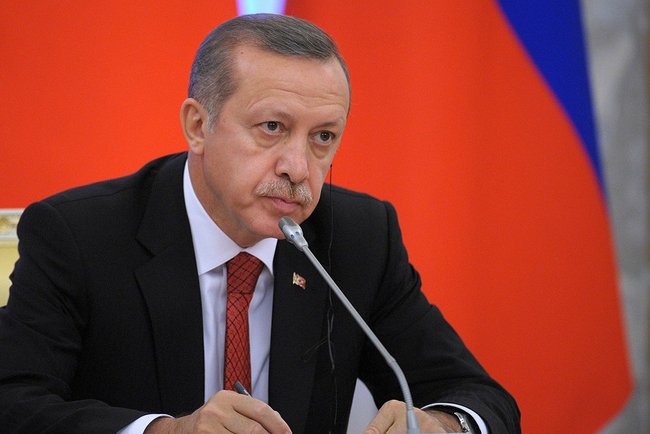 |
| Turkish PM Recep Tayyip Erdoğan. Wikimedia. |
1. Erdoğan's Speech
Although the link to my first source is a Guardian article, I'm only using the audio file that was embedded into the article. It was the only live English translation of Erdoğan's speech that I could find. The translator was from Al Jazeera, and that audio was taken and embedded into the article. One of Turkish President Erdoğan's staff probably wrote it for him, but for these purposes I'm going to consider him the author.
This speech was the initial spark that led to all of the controversy. It was given just hours after a suicide bombing in Istanbul killed ten foreign tourists, but focused on academics who signed an open letter about the crimes against Kurds in Turkey. He calls all of them ignorant terrorists, but Western media probably wouldn't have gotten involved if Erdoğan hadn't singled out one of America's most famous academics-- Noam Chomsky.
2. The Actual letter
Although it's unclear who the original author of this letter is, "We Will not Be a Party to This Crime" was signed by 1,128 Turkish Ph.D. holders and candidates, and 356 international academics (as of January 13). The letter demands a lift of 24 hour curfews, the end of the "deliberate massacre of Kurdish people," compensation for victims and their families, and for journalist to be allowed into areas of conflict.
The Voice of Jiyan describes itself as "a radical media experience focusing on news and developments from Europe and the Middle East." It may not be the most reputable source for objective news, but it provided an exact copy of the letter in multiple languages as well as up to date signatory numbers. Plus, the online declaration itself has been hacked and blocked by the Turkish government.
The only author provided in the article is "Jiyan." Writers for this site probably want to protect their identities. Writing "radical" news in or about the Middle East is enough to become a target for violent backlash.
3. Philosophy Student Arrested In Turkey
The Daily Nous is an online publication dedicated to "news for and about the philosophy profession." For this reason, they focused on the arrest of Jülide Yazıcı, a philosophy student at the most prestigious university in Turkey. She was one of the first three signatories arrested for "spreading terrorist propaganda." The petition for her release has 7,100 signatures as of February 4, 2016.
This article was released on January 31, as the aftermath of this controversy was still unfolding. Since then over twenty signatories have been detained. The article isn't extremely up to date, but it provided a great lens into how an individual was affected, instead of just giving numbers.
The author, Justin W., holds a Ph.D. in philosophy and regularly posts advice columns for philosophy grad students. He also analyzes new developments in the field of philosophy for the site. He has no clear connection to Turkey or the Kurds.
4. US Embassy Turkey Tweet
Statement by Ambassador John Bass on free expression pic.twitter.com/lqEOvP9Ijg— US Embassy Turkey (@USEmbassyTurkey) January 15, 2016
The US government very rarely criticizes Turkey publicly. We turn a blind eye to their attacks on the Kurds because they are our only NATO ally in the Middle East and, arguably, our second strongest ally against ISIS. Ironically, our current most important ally is the Kurds.
Anyways, my point is that it takes a lot for our State Department to speak against Turkey. The current ambassador, John Bass, has remained even more silent than his predecessors. This tweet came out on January 15th, just a few hours after reports of 27 academics being detained.
5. Yarın Haber Article
This article was posted on 2/3/2016 and written by Fadik Temizyürek. She has been a journalist for over ten years and seems to usually write political analysis pieces.
Yarın Haber (translation: News of Tomorrow) is an "independent" Turkish news organization. I put independent in quotes because all major publications, including this one, are heavily influenced and manipulated by the Turkish government.
This article describes the disciplinary procedures in place for signatories working at public universities, specifically Ankara University. It provides some specifics about the legality of signatories' participation in this letter. However, the essential piece of information from this piece that investigations of 121 faculty members have been opened and that some people are probably going to get fired.
6. American Sociological Association
They describe the actions of the Turkish government as an attack against academic integrity and freedom of expression. The letter is signed by past ASA president Paula England (professor at NYU), current president Ruth Milkman (professor at CUNY Graduate School), and president elect Michele Lamont (professor at Harvard University.) These three women are more than qualified to publicly discuss this attack on academic freedom.
7. Turkey Rounds Up Academics
The article was published on January 15, 2016 by Matthew Weaver. Before he joined the Guardian in 2001 he was the senior editor of an architecture magazine. Most of his recent stories are about US involvement in the Middle East, specifically Syria.True Kristalnacht ongoing in Turkey unreported by Western Media.Academics arrested&letters w threats hanged on doors pic.twitter.com/qnn8g1DxQS— Fer G (@FGunay1) January 15, 2016
The Guardian is a British newspaper dating back to 1821. It is currently owned by Scott Trust Limited, which doesn't seem to have any special interests in the Middle East.
8. Turkey: Where Calling for Peace is Terrorism
This article was posted on KurdishQuestion.com on January 22nd. It gives a great general overview of the situation while focusing on details that most other news organizations ignored. One signatory of the letter, Ayse Çelik, called into a popular Turkish talk asking people to look into the issue before believing what the media says about academics. Çelik is now being prosecuted for terrorism and the TV show is being investigated for spreading "terrorist propaganda."
The author of this article, Rosa Burç is a Ph.D. candidate at the University of Bonn in Germany studying nation-states and nationalism theory. Kurdish Question produces very little of its own material and instead pulls analyses from think tanks and short articles from other news outlets. This specific article was pulled from TeleSUR's website, a pan-Latin American television headquartered in Venezuela.
9. Protests Against Erdoğan in Ecuador
Turkish President Erdoğan faced large protests for his treatment of Kurds during his recent trip to Ecuador. His bodyguards ironically responded by attacking women who were chanting "violence out." The article was published on February 5th.
The news website Bianet was created by Ertuğrul Kürkçü, a left wing activist who is currently the honorary president of the HDP (majority Kurdish political party.) It is funded by the European Commission through their Instrument for Democracy and Human Rights.
The video that the website used was published by NOKTA (a Turkish media organization), but was essentially just live coverage from an Ecuadorean news channel.
10. Turkey Detains 21 signatories of academics for peace.
This piece was published on Vice News on January 15th, just a few days after Erdoğan publicly called the Academics for Peace group terrorists. It gives limited details about the academics who had been detained at that time, all from Kocaeli University near Istanbul.
The author attributed to this article is "Reuters and Vice News" -- they do not name a specific journalist. No large company owns a majority share of Vice Media and, in the article, they seem pretty neutral. They acknowledge how ridiculous the arrests sound but also bring up recent Kurdish violence.

No comments:
Post a Comment