Thursday, March 31, 2016

Rhetorical Analysis of Project 3

When I read the prompt for this assignment I immediately decided to write about Voluntourism. It isn't specifically related to either of my majors (Linguistics & Middle Eastern Studies) but it is an issue that I've been passionate about for a long time.

So many of my friends have gone on two week "service trips" and come back thinking they saved the world. However, they typically leave a negligible impact on communities they visit, often even taking jobs from more qualified locals.  I lived in Turkey for a year and regularly volunteered at a nursing home in my community. I was useless until I learned enough of the language to get by. In fact, the only time that my foreignness ever benefited the people I worked with was in I pretended to be a New York Times reporter so that a 103 year old woman could meet her President.

I'm inherently biased because I wanted to do these trips in high school. I thought I could fly to Zambia or Ghana or Uganda for the summer and save Africa. I suffer from the White Savior Complex even though I'm not really white. The fact that I'm American is enough. I was young, privileged, and naive.

I hope to target people who are considering paying thousands of dollars to participate in these "service trips." I want them to realize that it's okay to travel for the sake of traveling and to donate money instead of time to these causes. Participating in these trips is inherently selfish, but most people don't realize that. They can't save the world by forking over $2,000 for a plane ticket to Ethiopia, but they can do good and better themselves in other ways.

My audience most likely will consist of idealistic high school and college students who recognize their privilege and want to use it for good. I want to introduce them to better ways of using it.

I am nervous about the effectiveness of this video because I have so little experience with video editing. I made contributed to a few videos for the State Department website, but my only responsibility was creating raw footage. Anyone watching a video essay will expect a smooth experience with seamless transitions and sound effects. I may not be able to provide either.

There haven't been any recent laws passed about Voluntourism in the US or abroad. However, the UN recently released a report about orphanage voluntourism in Nepal after the earthquake. It outlines how the consistent flow of foreign funding encourages orphanage owners to keep the buildings in bad condition and even take children away from their families.

News about voluntourism only makes headlines directly after large scale disasters. However, my target audience will have likely already looked into programs or considered the decision to go abroad.

Voluntourism wouldn't be a billion dollar industry if it didn't have its proponents. The main argument that I will have to address (which I kind of agree with) is that of people who recognize that they are primarily helping themselves. They tend to call these experiences "service learning." It is considered part of a broader understanding of experiential learning.

The next argument is that voluntourists provide tangible services that the locals they are serving otherwise wouldn't have access to. This argument is typically cited by those participating in medical programs, building schools, or handing out mosquito nets. One of my favorite quotes from this side is from the International Service Learning website: "It feels amazing to help others who would otherwise be unable to receive medical treatment, and it definitely reaffirmed my desire to be a doctor."

This way of thinking is misguided at best. Foreign volunteers often suppress local economies and create a dependent relationship between the communities and the volunteer organizations. People in these communities don't train to be doctors because untrained teenagers come in every few months to give check ups and vaccines. You'll hear more about this in the actual video.

The third argument is that participants on these short term programs provide valuable intangible services to the communities they visit. This can be true when finance majors help local groups set up and expand small businesses or when nurses and doctors come in to train locals. This argument is valid when participants provide expertise to locals who can adjust the lessons to their own situations. Being the seventh volunteer to teach a group of orphans the ABCs, like in this video, does not count.


Sunday, March 27, 2016

Reflection on Post Production

Like most weeks, I was prepared to spend my entire weekend in the library silently kicking myself for not working on this project sooner. However, something strange happened this week. I sat down to write my paper on Sunday and I realized it was done.

There were still minor edits to be made like wording and choosing the most attractive page number placement. However, all of my content had already been typed and placed nicely into my rough draft. Instead of having separate "rough" and "final" drafts, I just progressively worked on the same google doc. I had spent so much time preparing for peer review that my work was already done.

It was so nice to not be stressed on Sunday night, especially since I had just finished Easter dinner with my boyfriend's parents in Phoenix. I'm proud of the final project I produced. It could have had more content, but every project could. I think I provided a solid explanation of new genres in my field and was able to present it in my favorite font.

I really don't want to start Project 3 because I was stupid and decided to do a video essay for the project that is worth the most points. I am terrible at editing videos. 

Editorial Report 9b

Like in my first editorial report, the form of the project didn't change too dramatically. The text was still written God forsaken Times New Roman and the paragraphs were made longer. Writing these blog posts in Times New Roman slowly kills me inside but I'm too lazy to change the font of every single post.

My content changed significantly between the rough cut and the final version of the project. I chose new genres to examine the day before the rough cut was due, so my information on crisis maps was lacking. As you can see, my fleshed out version is much longer and detailed that the original. I only examined one rhetorical strategy of this genre example in my first draft.


Edited Version
The Crisis Watch map, found on crisisgroup.org, is interactive and constantly updated with links to breaking news stories. It is a simple World Map that is color coded based on the progress of current conflicts within each country. Countries in which conflicts have deteriorated are colored red, those with more neutral updates are yellow, and those that have recently improved are green. As expected by pessimists everywhere, no countries are currently green.  The entire Middle East is yellow or red, with the exception of Jordan and the rich gulf states.
There are two icons that convey conflict progression in addition to the country colors. Potential conflict resolution opportunities are indicated with a blue cartoon dove carrying an olive branch. The only blue dove on the map is in Libya, likely representing the beginning of a new peacekeeping mission in the country. The dove, a Christian symbol of peace and hope, is an appeal to pathos. In the olive branch the bird carries a promise of new beginnings and the blue represents the potential for stability and tranquility (George Ferguson). This symbol encourages more hope than may be appropriate when considering the situation in Libya. The post-Arab Spring leadership, run by one of Qaddafi’s former generals, is at war with multiple militia groups and Daesh has recently claimed land in the country’s South (Alan Kuperman).
The second icon is a cartoon flame that represents a new conflict risk. The only current flame is in Burundi, where protests responding to the President’s run for a third term in office turned violent. The death toll is increasing on both the police and civilian sides. The red color and symbolism of the fire represent danger and increasing energy. The color red invokes physical responses such as increased heart rate and blood pressure (Colour Effects). These responses can affect the human thought process, making us more aware of potential danger.

The Global Conflict Tracker developed by the Council on Foreign Relations shares many similarities with the Crisis Watch map, including its function and use of color to invoke emotional responses (Global Conflict Tracker, Staff). Instead of assigning colors by the status of each conflict, colors are assigned by the supposed impact on US interests. Conflicts deemed “critical” to US interests are red with large circles, those deemed “significant” are orange, and those deemed “limited” are a calming teal. The color choice is rooted in the way humans physically and emotionally respond to certain colors, but the organization very much appeals to logos. The Council on Foreign Relations is an influential think tank located in Washington DC. It has 4900 employees who are constantly formatting global updates into digestible reports for policymakers, and a few who are clearly great graphic designers (Don Pollard). The target audience for this map is made up of professionals with US interests in mind who likely are too busy to read about violence in Central Africa if it doesn’t affect US interests. The severity of these conflicts is clearly not taken into account during sorting because violence in this region has killed more than Daesh has in the same time period (Global Conflict Tracker).

Rough Draft Version

The first Crisis Watch mapconflict map example, found on crisisgroup.orgNobelPrize.org, is interactive and constantly updated with links to breaking news stories. It’s a simple World Map with orange dots representing ongoing conflicts around the world. The dots are color and size coded based on the category of conflict (protest, armed government conflict, guerilla warfare, etc.) and the severity of the most recent updates.  The Middle East is the region with the most frequent updates, but everything from police brutality protests to the Hatian election is covered.

Editorial Report 9a

I edited my Rough Cut directly, so the section I pulled is from the "track changes" part of google docs. This is my (very) rough introduction, with the clear edits marked.

When I was writing the introduction for my rough draft I was really just trying to get words on the page. The tone was too casual and it wasn't really cohesive. However, I was able to just move the same ideas into sections where they fit better. 

This paragraph didn't really change in terms of form. The whole page looks very different compared to where it was as a rough draft, but the intro is shorter. I also changed the font from Times New Roman to Helvetica-- I am a firm believer that using TNR is just proof that you didn't give a shit about font choice. Helvetica is timeless and professional and very readable on a computer screen. 

You may have noticed that this is written in TNR. That's because I don't give a shit about font choice right now. 

Edited Intro


The rise of the Internet has remarkably changed how academics in Middle Eastern Studies work and research. This is apparent in new forms of academic media, such as interactive multimedia projects and constantly changing conflict maps, which are almost exclusively found online. Instead of targeting other academics, these are typically geared toward a younger, more tech savvy audience than traditional journals. This paper will analyze interactive online multimedia experiences and conflict maps to portray a small section of academia’s internet age.

Rough Cut Intro


The rise of the Internet has drastically changed how academics in Middle Eastern Studies work and research. This is apparent in new forms of academic media, such as the interactive multimedia projects and constantly changing conflict maps, both of which are often found online. Instead of targeting other academics, These are typically geared toward a younger, more tech savvy audience than traditional journals. , as well as changes to the traditional research process. Academics of the dark ages (roughly twenty years ago) often traveled to the Middle East and spent months in archives searching for relevants facts. Now researchers can find exactly what they are looking for using keyword searches in online databases. The first process is tedious and the amount of available information can be overwhelming. However, it provides a thorough, detailed view of the time period in a way that the modern process doesn’t. This paper will analyze interactive online multimedia experiences and conflict maps to portray a small section of academia’s internet age. journal articles written between 1976 and 2013 to provide a glimpse into how the field of Middle Eastern Studies has adapted to the modern era.

Peer Review 9b: Eren ArbaƧ

Eren ArbaƧ is a student in Section 4. His project  had solid content but was lacking in form when I reviewed it.

I pointed out aspects of the essay that had simple solutions such as adding page numbers and changing the works cited page to be in proper MLA format. The essay was also lacking a title and in-text citations, so I gave suggestions about incorporating those as well. Form is worth just as many points as content and sloppy work could cost authors multiple letter grades.

I appreciated how concise Eren's essay was. At first glance it appeared very short but it wasn't lacking in content. My writing tends to be very verbose and I think I could learn a lesson in clarity from Eren's project.

Peer Review 9a: Tim Wils

I reviewed Tim Wils' podcast. He had great content and managed to explain the theater genres while maintaining the listener's interest. This was likely because the examples he chose had an audio component to them already-- he added audio clips from plays and workshops to show the reader exactly what he was discussing.

I chose to provide form suggestions. The music and sound effects at the beginning of the project were great and really hooked the listener's interest. Plus that was the most enthusiastically I've ever heard anyone explain rhetorical strategies. 

However, the sound effects and music are lost after the first minute or so. The listener who was hooked at the beginning starts looking around for distractions. Even I started typing this as the podcast was still playing. I recommended that he incorporate more supplemental sounds to make the podcast more dynamic and keep the reader interested. 

One thing I took from the podcast was the effectiveness of enthusiasm. If the author sounds like they care about the issue (even something utterly boring) the reader at least tries to care as well. I wrote an essay so incorporating that enthusiasm was a little more difficult. However, I went back and tried to make my arguments appeal directly to the reader. 

Sunday, March 20, 2016

Reflection on Production

I should have gotten so much more done this week than I actually did. The rough cut on my blog is lacking in detail because I decided to change directions about twelve hours ago. However, I know that I'll have a good draft to present by the time peer review rolls around.

This week wouldn't have been as productive as I wanted it to be even if I hadn't changed directions. I stressed myself out because of exams this week and just needed to decompress on Saturday. Even though I didn't get much work done for this class I'm sure you'd be happy to know that I read two whole books (you are an English teacher after all.) They were real books with paper and chapters and everything.

I'm confident that I'll be able to pull something good out of my ass by Tuesday for peer review and polish it before the final project is due. I just needed to take some time for myself and adjust my schedule accordingly. 

Saturday, March 19, 2016

Open Post to Peer Reviewers

Here is link to my current rough draft. It's still a work in progress and I haven't added my citations or works cited yet.

In one of my first examples I described the piece using second person. I switched to third person halfway through the paper so that you could compare the two and comment on which you prefer as a reader. 

Friday, March 18, 2016

Production Report 8b

I haven't run into any significant issues while working developing this piece of my project. However, I've been extremely lazy about citations while working on my rough draft. I have a list of links to sources that I've used so far and plan to develop my Works Cited page and in texts citations during post production. So far I just have the word "citation" in parenthesis reminding me what facts I need to cite.

I switched one of the genres that I analyzed from journal articles to conflict maps. This isn't a significant issue but I had to redo my outline. I'm a very visual person and would rather analyze the visually intriguing aspects of a genre (even in Middle Eastern Studies) than analyze three ten page journal articles. The articles were interesting to read but my analysis just felt dry and boring.

Outline Excerpt 

    • Crisis Watch
      • Color code
        • Dove & Flame -- pathos
        • Physical responses to colors
        • Symbolism

Text Excerpt
The first Crisis Watch map, found on crisisgroup.org, is interactive and constantly updated with links to breaking news stories. It’s a simple World Map that is color coded based on the progress of current conflicts within each country. Countries in which conflicts have deteriorated are colored red, those with more neutral updates are yellow, and those that have recently improved are green. As expected by pessimists everywhere, no countries are currently green.  The entire Middle East is yellow or red, with the exception of Jordan and the rich gulf states.

There are two icons that convey conflict progression in addition to the country colors. Potential conflict resolution opportunities are indicated with a blue cartoon dove carrying an olive branch. The only blue dove on the map is in Libya, likely representing the beginning of a new peacekeeping mission in the country. The dove, a Christian symbol for peace and hope, is an appeal to pathos. In the olive branch the bird carries a promise of new beginnings and the blue represents the potential for stability and tranquility (CITATION.) This symbol incites more hope than may be appropriate when considering the situation in Libya. The post-Arab Spring leadership, run by one of Qaddafi’s former generals, is at war with multiple militia groups and Daesh has recently claimed land in the country’s South (citation.)

Production Report 8a

I wrote this section of my essay in standard paragraph format. I was wary of using the second person because it isn't often used in college essays. However, I felt that using the second person made a stronger impact on the audience than clinical objectivity would. The entire point of the piece I analyzed was to put the participant into the refugee's shoes. I would have been doing my readers a disservice if I didn't attempt to create the same feeling for them.

This material wasn't difficult to produce because I've had experience writing essays in the past. I would have come across a lot more issues if I had done a podcast or video essay for this assignment. Also, since text is very easily revised and edited I can view this a more fluid work in progress than I would a video essay.

Outline Item 

From Middle East Monitor Section:

          1. Ethos
            1. Deciding to stay or flee
            2. Clicking stay results in a cell phone video of French airstrikes on Raqqa, Syria’s capital. He is standing on the roof of a concrete building and filming the surrounding buildings as they are obliterated by missiles.  The civilian behind the phone prays for his life.

Raw Text Excerpt
The Middle East Monitor’s interactive “A Refugee’s Journey” is essentially a sleeker, more modern version of the Oregon Trail era “Choose Your Own Adventure” games with more altruistic intentions. The game forces the audience into the shoes of a refugee, requiring split second decisions that could mean life or death. Each time the player narrowly escapes death, whether by spending their savings on fake papers to leave Syria or by jettisoning the fresh water supply so their overcrowded rubber boat doesn’t sink, they are forced into yet another difficult decision. It is impossible not to feel helpless as the death toll rises, even while the player collects small victories of survival.
The first decision you face is whether or not to stay in Raqqa, Syria’s capital. Your family has lived in the city for centuries but France is drastically increasing airstrikes in the aftermath of the 2015 Paris Attacks. Daesh (the Islamic State of Syria and Iraq) has shut down the internet and is fortifying the city. If you flee to another part of Syria you must leave your family behind. You decide to try your luck at home and confidently click the blue “Stay” button. Your screen turns completely gray. When the next explosion goes off, you realize it’s not a computer virus. It’s just smoke from the French bombing Raqqa. The video was clearly shot with a cell phone by a man standing on top of the building. The man prays for his life in the background and hopes the pilots see him.  Bombs obliterate surrounding buildings one after another until the video abruptly stops as the phone falls.
It’s clear that you can’t stay in Raqqa, so you decide to abandon your family and flee to another part of Syria. You click this button slightly less confidently than you did the first. The next thing you see is a complex orange map of Syria. It illustrates the territories controlled by Daesh, the Syrian government, and rebel forces, as well as hard to reach areas which haven’t received aid in months. It also includes where the other 7.6 million internally displaced Syrians fled to. Roughly 35% of Syrians are displaced within their own country and millions more have attempted the dangerous journey to Europe. You consider where to go next as you wait for the UN food convoy to arrive. What will you do?
That was only the first three scenarios of the dozens that are available. Within your first two clicks you were bombarded with emotionally devastating footage as well as enough hard facts to make even the most heartless statistician empathize with refugees.
The first video was a clear appeal to ethos. The man begging for his life behind the cell phone could have been anyone. This footage works especially well with the interactive format because the player feels like they are standing on top of that building watching their own community be destroyed. The Middle East Monitor, which targets young professionals and students  interested in global affairs, provides a stark contrast from the very pro-Western depiction of the war on ISIS as displayed on European and American news outlets. Instead of immediately hitting the player with a video of ISIS attacks, they show the devastation that airstrikes, specifically those of the French, cause to civilians. These strikes have been widely supported by the American public. When presidential candidate Ted Cruz proposed to “carpet bomb Syria until we see if sand glows in the dark,” he received standing ovations (CITATION.) Players from the US and Western Europe likely feel guilty for the destruction that their nations have caused. Players feel both the helpless fear of the refugee and the partial responsibility for forcing this refugee to make the decision.

Monday, March 7, 2016

Content Outline

Some parts of this outline are definitely more fleshed out than others. I've already done most of my analysis on the interactive media examples, but just received the email examples that I will be using. These emails haven't been redacted so I didn't feel comfortable linking them to the outline.

Content Outline
via Blogspot


Production Schedule

When I got the flu I decided to switch to making a traditional essay (I was initially planning to create a video essay.) This is was partially because I didn't know when I would sound well enough to do voiceovers and partially because the flu tends to make people lazy.

I've pretty much dedicated my week to studying for exams and clearing out my room (how does one person go through so many jars of peanut butter??) since I'm moving out on Friday.

 I typically rely on short bursts of productivity anyways. It shouldn't be difficult to squeeze out two paragraphs of content every day until I have time to sit down and dedicate ten straight hours to this project. Hopefully that will be Saturday but between move-in and meeting my residents that don't fly out until Sunday (or later) to save money I might end up scrambling at the last minute again. 

What needs to be done: 
1. Wednesday: A more "beefed up" outline with full citations (I like to just keep adding to outlines until they kind of turn themselves into a paper.) Get sample emails from Noorani and Fortna
2. Thursday: Remove bullets and incomplete sentences. Format it into a standard essay. 
3. Friday: Revise content heavy sections so they are concise but not too dense. 
4: Saturday: Revise opening and closing paragraphs so they get (and keep) the reader's attention.
5: Sunday: Dedicate to catching up on anything didn't get done

Reflection on Pre-Production Week

This past few weeks have been rough. I got the flu right before the first initial deadline, had my second interview cancelled on me, then was offered a last minute RA position and have been packing up all my stuff before I move.

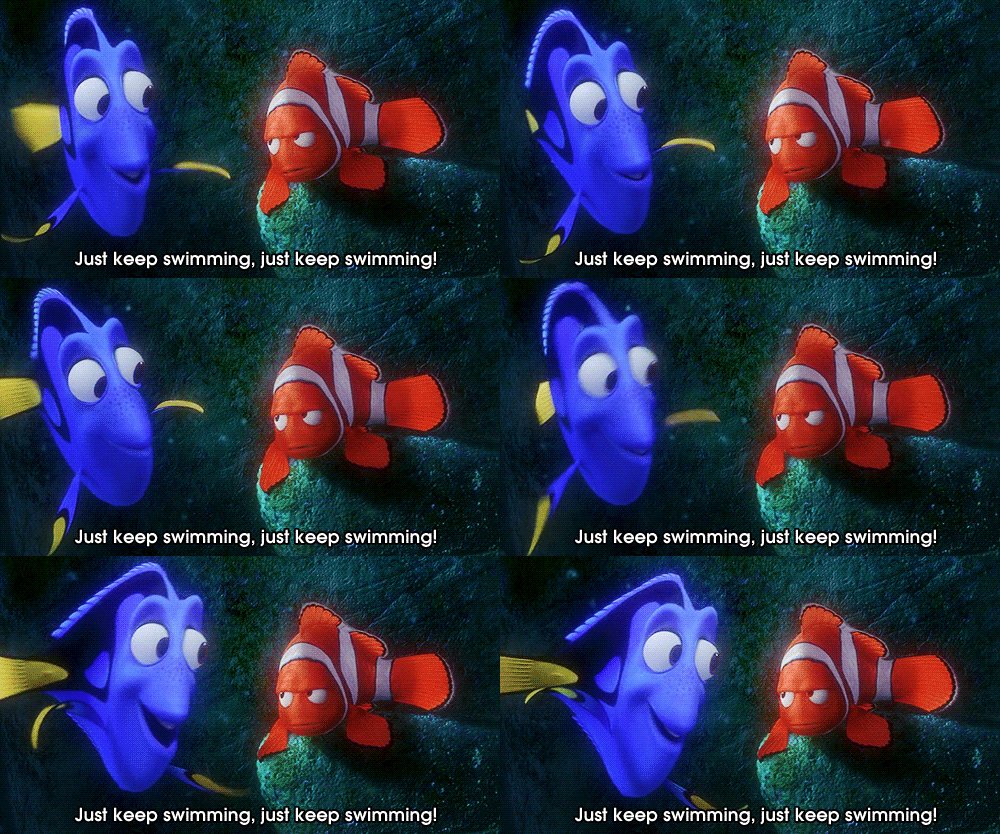
I definitely let English fall to the back burner. I'm still working on catching up. I feel that I have enough content to move forward with this project but my life is a jumbled mess. I don't know if I'll ever feel as "on track" as I did with the first project. That's okay. I just have to keep swimming.
via Giphy

Sunday, March 6, 2016

My Discipline

I spent a long time thinking about the question "what do students in my major learn how to do?" We learn a lot of facts about the Middle East and at least one language, but that's not really an answer. Just like most majors in the social sciences, the MENAS program teaches students how to conduct and present academic research. It also teaches students how to approach complex situations from different perspectives through required courses like Introduction to Islamic Thought.

Some people with MENAS degrees decide to stick around Tucson and work as baristas. However, many also move to DC and become analysts, either as bureaucrats or government contractors. Some become interpreters, reporters, aid workers, or teachers. Many earn graduate degrees and stay in college forever.

There aren't many exciting people in this field right now. Some organizations like the Council on Foreign Relations and Foreign Affairs have a lot of influence on public opinion and government action. The field of journalism also regularly overlaps with MENAS, and Al Jazeera is one of the most influential Middle East focused news sites.

Arab Studies Quarterly, Middle East Report, and (my favorite) the International Journal of Kurdish Studies are all relatively influential within the field. It is more often, however, for academics to publish Middle East focused work in larger International Relations journals. The Middle East Report and the International Journal of Kurdish Studies are located in Britain. Arab Studies Quarterly's headquarters is in Jordan.

My Interviewees on Social Media

I lucked out on this blog post. I only had one interviewee and he describes himself as being "allergic" to social media. His online presence consists of pages that were developed for him by the universities he's worked at.

He has no Facebook, Instagram, LinkedIn, Reddit, Tumblr, Twitter, Wordpress, or Youtube account. When I asked this question, however, he did go on a five minute rant about email. 

Saturday, March 5, 2016

My Interviewees as Professional Writers

My other interviewees were unavailable and the one that I had scheduled cancelled on me, so I am going to focus on the work of Dr. Benjamin Fortna.

Fortna has several publications out including The Imperial Classroom: Islam, Education and the State in the Late Ottoman Empire (Oxford University Press, 2002), The Modern Middle East: A Sourcebook for History (Oxford University Press, 2005), and Learning to Read in the Late Ottoman Empire and the Early Turkish Republic (Palgrave Macmillan, 2010). He also appeared on several BBC programs while he worked in London.

He has published two books and a few of his appearances on Who Do You Think You Are are available here. The books contain large amounts of information and provide more of a historical survey than journal articles do.

On the BBC show he was presenting information to someone with a personal interest in his family's history. that information has to be understood by people who don't know much about the Ottoman Empire or ancestry in order to make interesting television. Both the genre and the audience are dramatically different from his usual work. 

My Interview Subjects

This week I interviewed Dr. Benjamin Fortna. I have also reached out to several other professors, but we haven't scheduled anything yet.


Dr. Fortna works for the University of Arizona as the director of the Middle East & North African Studies department. His research focus on the culture of the late Ottoman Empire and the early Turkish republic. He has graduate degrees from the University of Chicago and Columbia and an undergraduate degree from Yale.

I don't know how long Fortna has worked in this field, but the earliest of his works that I was able to find was published the late 1980's. Fortna has a short biography on the University of Arizona website but is not active on social media.

Benjamin Fortna's picture
Benjamin Fortna
Interview Questions:

1. What is the genre you most often find yourself writing in?
2. Do you prefer writing for academic audiences or more general audiences?
3. How does your approach differ when writing for other academics instead of general audiences?
4. Was your experience on Who Do You Think You Are your first time working in multimedia genres? If so, was presenting research on film significantly different than what you are used to?
5. How has the research process changed since you started working in this field?
6. Are there any skills that you think younger academics are lacking in because of technological advancements?
7. Are there any skills common among younger academics that you struggle with?
8. How are the writing situations you face in this administrative position different from the ones you faced as a student and researcher?